Om
The sacred syllable of Hinduism. Beautiful, and with rules about where it goes.
The Mandukya Upanishad, one of the shortest of the ancient Indian texts, is only twelve verses long, and it is almost entirely about one syllable. A-U-M, it says, is everything: the A is waking, the U is dreaming, the M is deep sleep, and the silence after the sound is what lies beyond all three. Om still opens and closes prayer for more than a billion people. Worn with respect, it goes high on the body, as this one does.
Handle with care
The story
Om, also written Aum, is a sacred sound before it is a shape. In the Vedic texts of ancient India it is the syllable that opens and closes prayer, and the Upanishads treat it as the sound of everything: the three parts A, U and M are read as waking, dreaming and deep sleep, or as creation, preservation and dissolution. In Hinduism it stands for Brahman, the ultimate reality, and for the self within. Buddhists chant it at the start of mantras such as Om mani padme hum. Jains and Sikhs hold it sacred too, in their own forms.
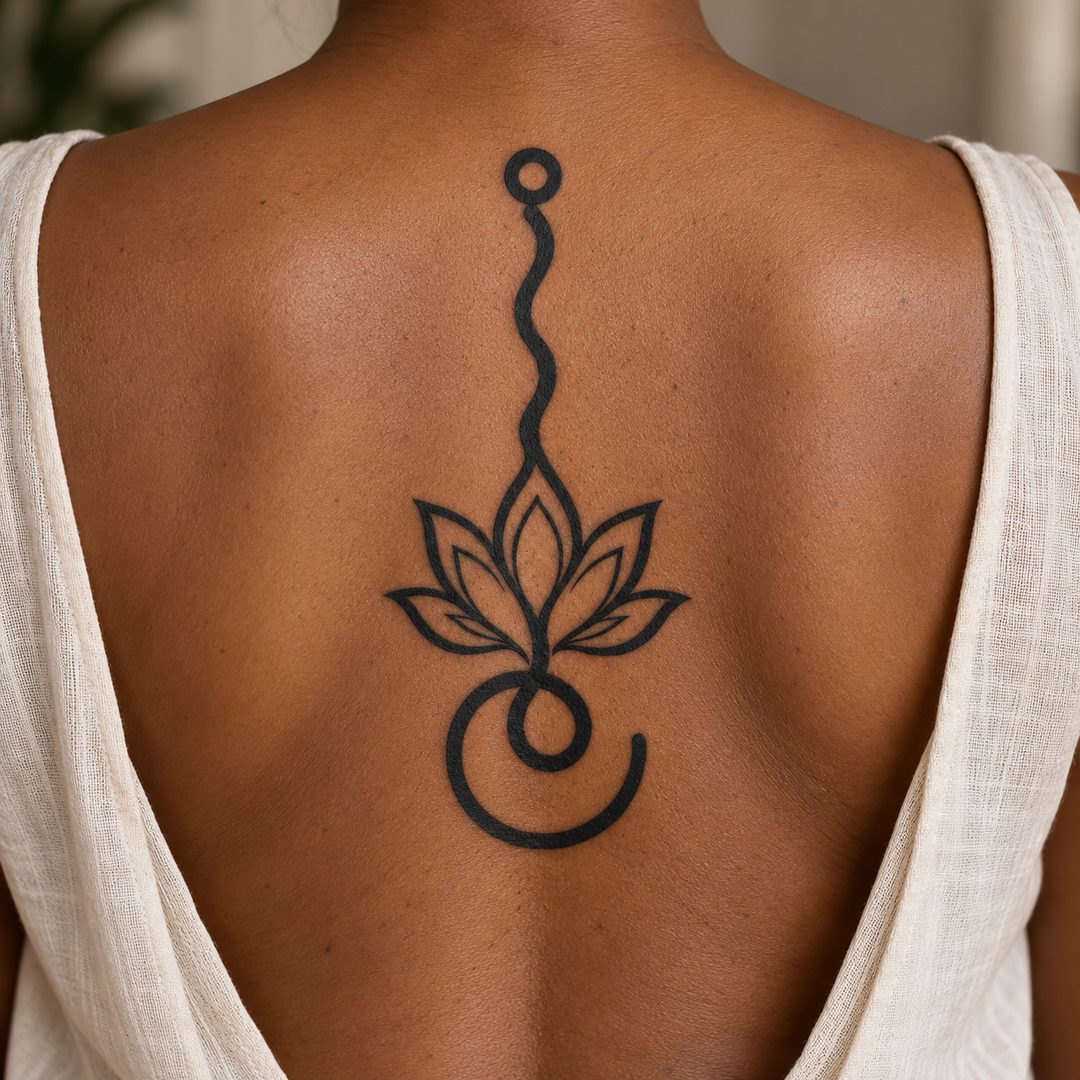
The shape most people know is the Devanagari sign, a curling figure with a crescent and a dot above it. Tamil, Tibetan and Balinese scripts each draw it differently, and in Thailand and Cambodia it is often merged with the unalome.
Yoga carried Om around the world, and with it came the tattoo. That has caused friction. In Hindu practice sacred things are kept high and clean, and the feet and legs are treated as low. When a Hollywood singer had Om tattooed on her thigh, Hindu leaders publicly called it disrespectful. The sign is welcome on non-Hindus; where it sits is what matters.
What it means
- Hindu
- The sound of creation; Brahman, the whole of reality.
- Buddhist
- The opening of mantras; the body, speech and mind of the Buddha.
- Jain and Sikh
- Sacred in both, in their own written forms.
- Yoga practitioners worldwide
- Breath, beginning and end, stillness.
Best place to wear it
Inner forearm Top pick
High on the body, seen every day, and the flat skin keeps the letter clean.
4 to 8 cm
Pain 3/10 · heals in about 14 days
Upper arm (outer)
Above the waist, easy to cover, ages well.
5 to 10 cm
Pain 3/10 · heals in about 14 days
Upper back
Between the shoulder blades, at the top of the spine: the most respectful spot.
6 to 12 cm
Pain 4/10 · heals in about 21 days
Get it right
Get the script right. The Devanagari Om has a specific shape: the main curl, the tail, the crescent and the dot. Artists who draw it from memory get the tail backwards or leave off the dot, and to anyone who reads it that is a misspelling on your body for life. Bring a printed reference and, if you can, have someone who reads Hindi or Sanskrit look at the stencil. Never mirror it. Keep it above the waist: forearm, upper arm, chest, upper back or the nape. A lotus underneath it is common and reads Hindu or Buddhist depending on the flower. Simple, bold lines suit it best; it is a letter, not a picture, and ornament around it should not swallow the letter.
Styles that suit it
Related
Sources
Researched from the sources below; cultural review pending.