Lotus
Grows from mud, opens clean. Purity you earned rather than inherited.
The Egyptians watched the blue lotus close at dusk and sink under the water, then rise and open again at dawn, and made it the flower of the sun's rebirth; it is painted all through Tutankhamun's tomb. India drew the other lesson: the lotus roots in mud and opens clean above the surface, never stained by it, which is why the Buddha sits on one. Both saw the same thing. On skin it says it too: you can come up clean out of the dark, and open on time.
Worth knowing
The story
The sacred lotus, Nelumbo nucifera, roots in mud at the bottom of a pond and opens a spotless flower above the water. Buddhism made that the whole teaching: a person can rise out of suffering and attachment without being stained by it. The Buddha is shown seated on a lotus, and the number of petals and the colour each carry meaning, white for purity of mind, pink for the Buddha himself, blue for wisdom, red for love and compassion.
In Hinduism the lotus (padma) is older still. Brahma is born from a lotus growing out of Vishnu's navel, and Lakshmi stands on one. The chakras are drawn as lotuses with a set number of petals. Ancient Egypt had its own version, the blue water lily, which closes at night and opens at dawn and so stood for the sun and rebirth; it is a different plant, but the meaning travelled.
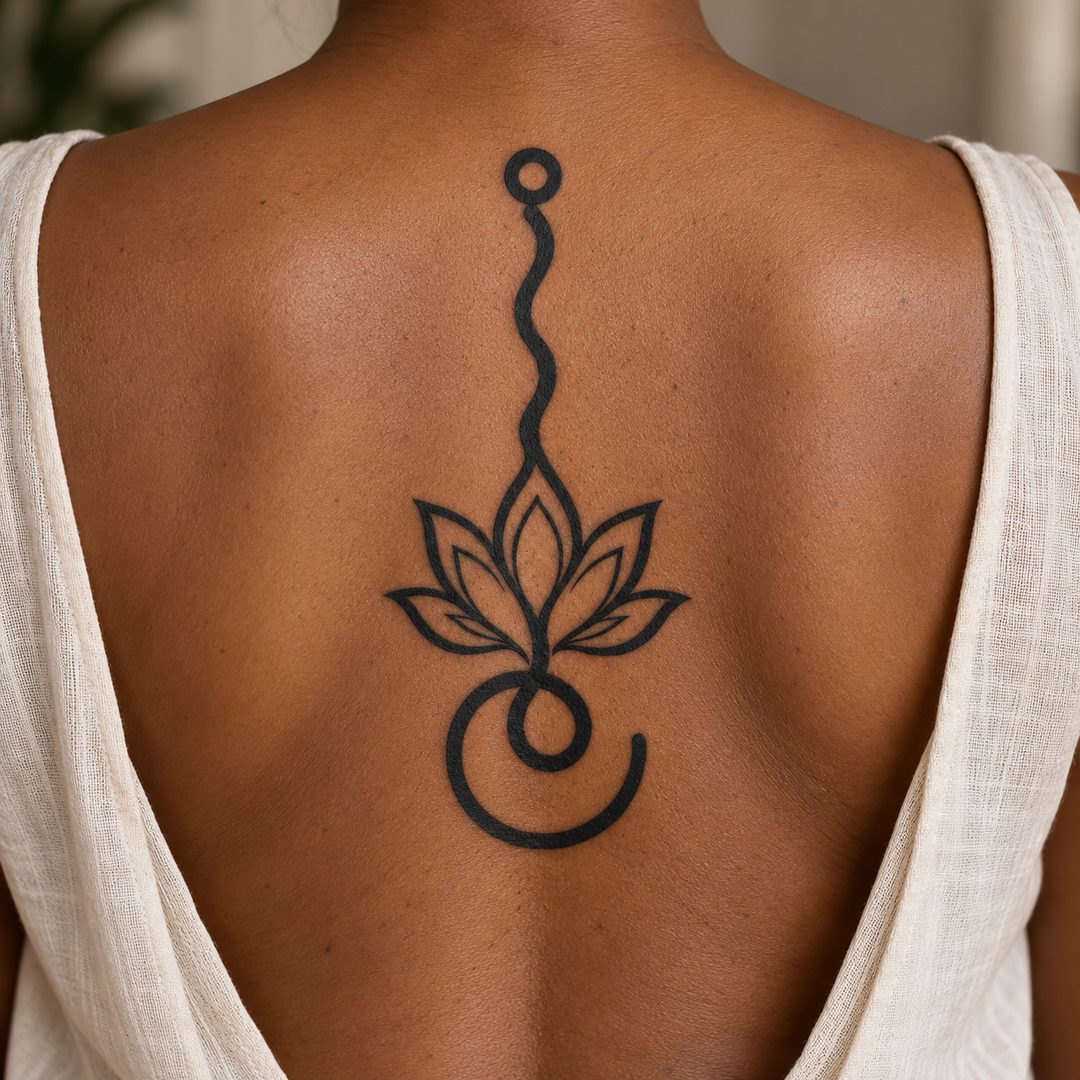
In Japanese tattooing the lotus sits with the koi as a symbol of perseverance. The modern fine-line lotus, often on the sternum or spine and sometimes joined to an unalome, came through yoga culture in the 2010s. Most people who wear one mean something close to the Buddhist reading: I came through something, and I came through it clean.
What it means
- Buddhist
- Enlightenment rising out of suffering. Purity unstained by the mud.
- Hindu
- Padma: divine birth, beauty, the seat of Lakshmi and Brahma.
- Ancient Egyptian
- The sun, creation and rebirth (the blue water lily).
- Modern
- A new start after a hard time. Calm and self-possession.
Best place to wear it
Sternum Top pick
The symmetrical flower suits the centre line. Bone under thin skin, so it stings.
6 to 12 cm
Pain 8/10 · heals in about 21 days
Inner forearm
Easy first placement; a small lotus with the stem along the arm.
4 to 8 cm
Pain 3/10 · heals in about 14 days
Spine
A lotus at the top of the spine, alone or above an unalome.
5 to 10 cm
Pain 8/10 · heals in about 21 days
Get it right
Petals need space between them, exactly as with a rose; a lotus whose petals touch becomes one shape in five years. Ask the artist to leave clear skin breaks and to keep petal outlines slightly heavier than the inner lines. Choose open or bud on purpose, since an open flower is the finished journey and a bud is the beginning. A lotus on the sternum or spine must be perfectly centred, so ask for the stencil to be checked standing straight in a mirror. Dotwork shading holds beautifully here. A simple line lotus works at 3 to 5 cm; a realistic one wants 8 cm or more.
Styles that suit it
Related
Sources
Researched from the sources below; cultural review pending.