Valknut
Odin's knot of three triangles. Real Norse history, and a modern problem.
On the island of Gotland, Viking Age carvers raised picture stones taller than a man. On the Stora Hammars stone, among scenes of battle, sacrifice and a hanging, sit three triangles locked into one another. Nobody wrote down what they meant; even the name valknut, knot of the slain, came a thousand years later. What is left is a shape that stood beside the dead and the god who chose them, and still asks you to face the end with courage.
Handle with care
The story
The valknut is three interlocked triangles. It is carved on the Stora Hammars and Tangelgarda picture stones from Gotland in Sweden, and it appears on objects from the Oseberg ship burial in Norway, all from the Viking Age. On the stones it sits beside scenes of death, sacrifice and the god Odin, which is why scholars connect it with Odin and with the slain. One reading is that it shows Odin's power to bind and unbind the mind. The truth is that no one wrote down what it meant, and even the name is modern Norwegian, roughly 'knot of the slain'.
Modern heathens, people who practise the revived Norse religion, wear it as a sign of devotion to Odin and of courage in the face of death. That use is sincere and growing.
Alongside it, some white-supremacist groups have adopted the valknut as a badge, and the Anti-Defamation League lists it among hate symbols, while noting plainly that non-racist pagans use it too and that context decides. That is the honest position. The symbol is not racist. Some of the people wearing it are, and anyone else who wears it should know that before it is on their skin.
What it means
- Norse (scholars' best reading)
- Odin, the dead, and the binding and loosing of the mind.
- Modern heathen
- Devotion to Odin; readiness to die well.
- Extremist use, unwanted
- Adopted by some white-supremacist groups as an identifier.
Best place to wear it
Upper arm (outer) Top pick
Easy to cover, easy to show, and room for runes or a raven around it.
8 to 12 cm
Pain 3/10 · heals in about 14 days
Inner forearm
Visible, so give it context. Flat skin keeps the triangles sharp.
6 to 10 cm
Pain 3/10 · heals in about 14 days
Chest
Over the heart, where heathens often wear it, with room for context.
10 to 15 cm
Pain 6/10 · heals in about 21 days
Get it right
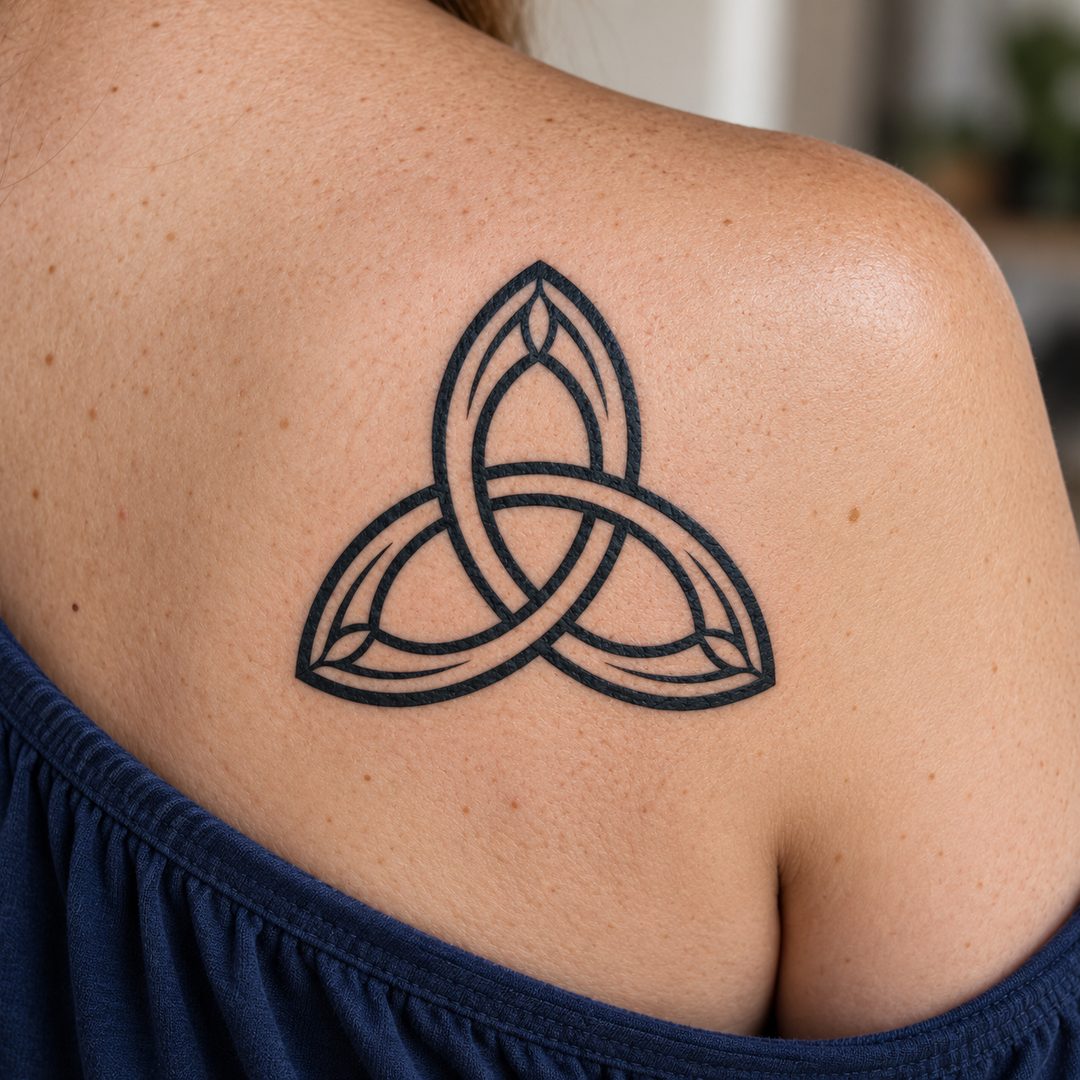
There are two forms: three separate triangles woven together, and a single unbroken line that draws all three. Both are on the stones, so both are correct; the single-line one is harder to draw well and needs an artist who does geometry. Bold black suits it. The surest way to make it read as Norse heritage rather than something uglier is context: runes, a raven, Yggdrasil or a ship around it say what you mean. A bare valknut on the neck or hand says nothing, and other people will fill in the blank. If you have no Norse roots or belief and just like the shape, the triquetra gives you a three-part knot without the baggage. Whatever you choose, be ready for the question 'why that one?'
Styles that suit it
Related
Sources
Researched from the sources below; cultural review pending.