Triquetra
Three arcs woven into one knot. Trinity to some, three worlds to others.
Some twelve hundred years ago, monks on the island of Iona began a book so rich it is still called the most beautiful ever made. In the margins of the Book of Kells, among the lions and the knotwork, three arcs weave into one and never end. Nobody wrote down what the monks meant by it. Christians came to read the Trinity, pagans three worlds. Everyone agrees on the knot itself: three parts, one thread, no beginning.
Worth knowing
The story
The triquetra is a knot of three pointed arcs, sometimes with a circle woven through. The shape is ancient and turns up on pottery from Anatolia and Persia from around the fourth century BC and on early coins. It became famous through the Insular art of Ireland and Britain, where it fills the margins of the Book of Kells and the metalwork of the seventh century onward, and it appears on Norse runestones and early Germanic coins too.
What the medieval artists meant by it is not recorded. The reading of it as the Christian Trinity, three in one, dates from the nineteenth-century Celtic Revival, when scholars began describing it that way, and it has been a Christian symbol since. Modern pagans read it as the Triple Goddess, or as land, sea and sky. A 1990s television series made it a sign of three witches. None of these readings is wrong, and none is the original.
As a tattoo it is a favourite of people with Irish, Scottish or Norse roots, and of anyone who wants a Trinity symbol that is not a cross.
What it means
- Christian (Celtic Revival onward)
- The Trinity: three persons, one God.
- Celtic and Norse
- Original meaning unknown. Often read as three realms or three stages of life.
- Wiccan and neopagan
- The Triple Goddess; protection.
Best place to wear it
Inner forearm Top pick
Flat skin keeps the crossings clean. Easy to see, easy to cover.
4 to 8 cm
Pain 3/10 · heals in about 14 days
Wrist
A small knot on the wrist is a long-standing choice. Keep the lines bold.
3 to 4 cm
Pain 5/10 · heals in about 14 days
Shoulder blade
Room for a larger triquetra with knotwork around it.
8 to 12 cm
Pain 4/10 · heals in about 14 days
Get it right
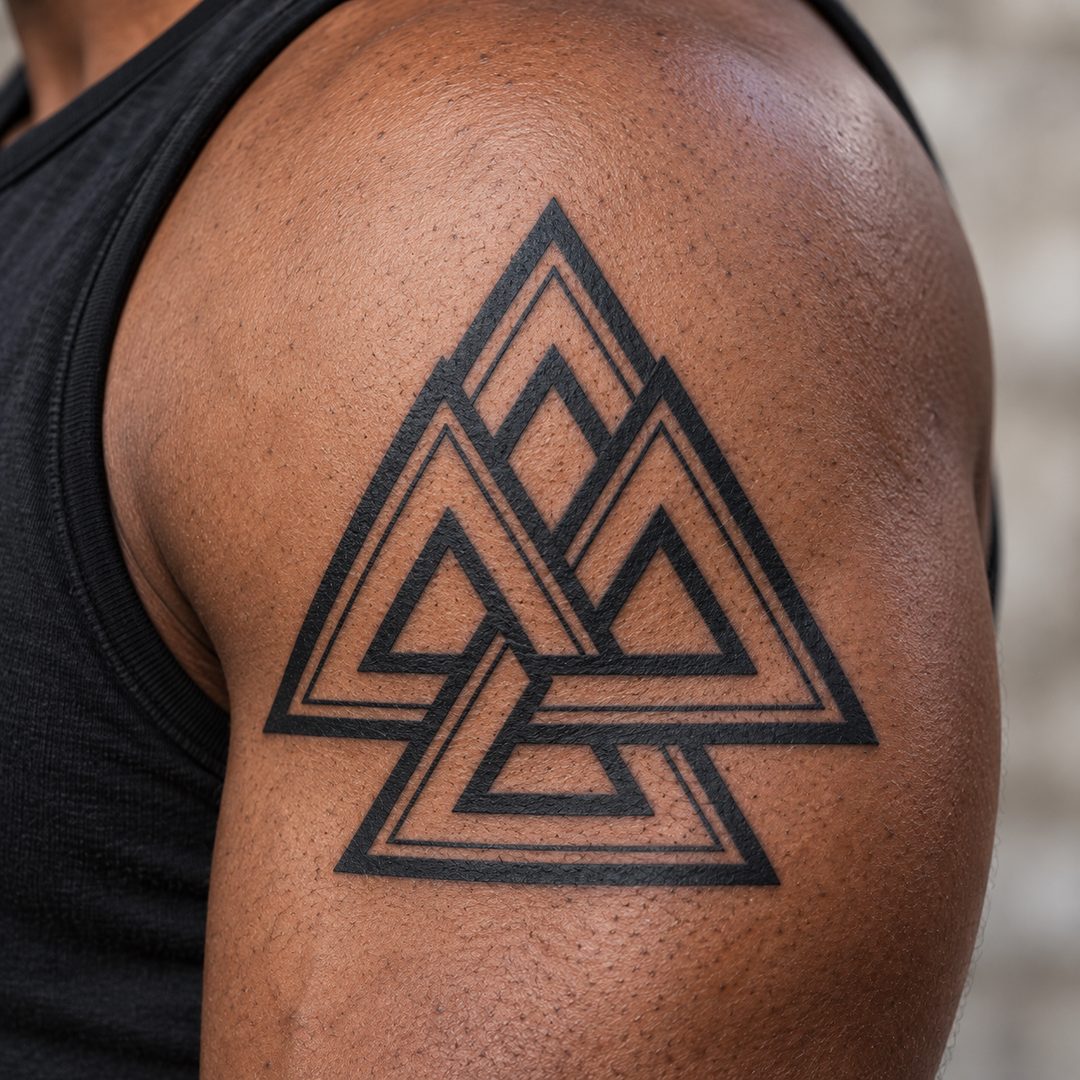
It is a knot, and knots must go over, under, over, under all the way round. An artist who has never drawn knotwork will get one crossing wrong, and once you notice it you will never stop noticing. Ask to see knotwork they have done and count the crossings. Decide on the plain triquetra or the version with a circle woven through, which reads more clearly as Trinity. Bold lines hold the over-under better than thin ones as the years go by; below four centimetres the crossings fill in. Do not confuse it with the valknut, which is three interlocked triangles and comes with a very different story. If you want Celtic knotwork around it, keep the triquetra itself as the clear centre.
Styles that suit it
Related
Sources
Researched from the sources below; cultural review pending.