Arrow
Pulled back before it flies. Direction, and the strength to be released.
In 1737 the French engineer Bernard Forest de Belidor printed a small arrow in a book on hydraulics, to show which way water drove a wheel. It is the earliest known arrow used as a sign for 'this way'. The weapon is tens of thousands of years older; the direction is new. Two arrows side by side are usually two people heading the same way. An arrow only flies because it was first pulled back.
Worth knowing
The story
Arrows have been weapons for tens of thousands of years, but the arrow as a sign meaning 'this way' is surprisingly new. The earliest known printed one appears in a French engineering book of 1737, showing which way water turned a wheel. Mapmakers picked it up for rivers, and by the 1800s military maps used plain arrows for the movement of armies. Somewhere in that century the arrow stopped being a drawing of a weapon and became the universal symbol of direction we cannot imagine living without.
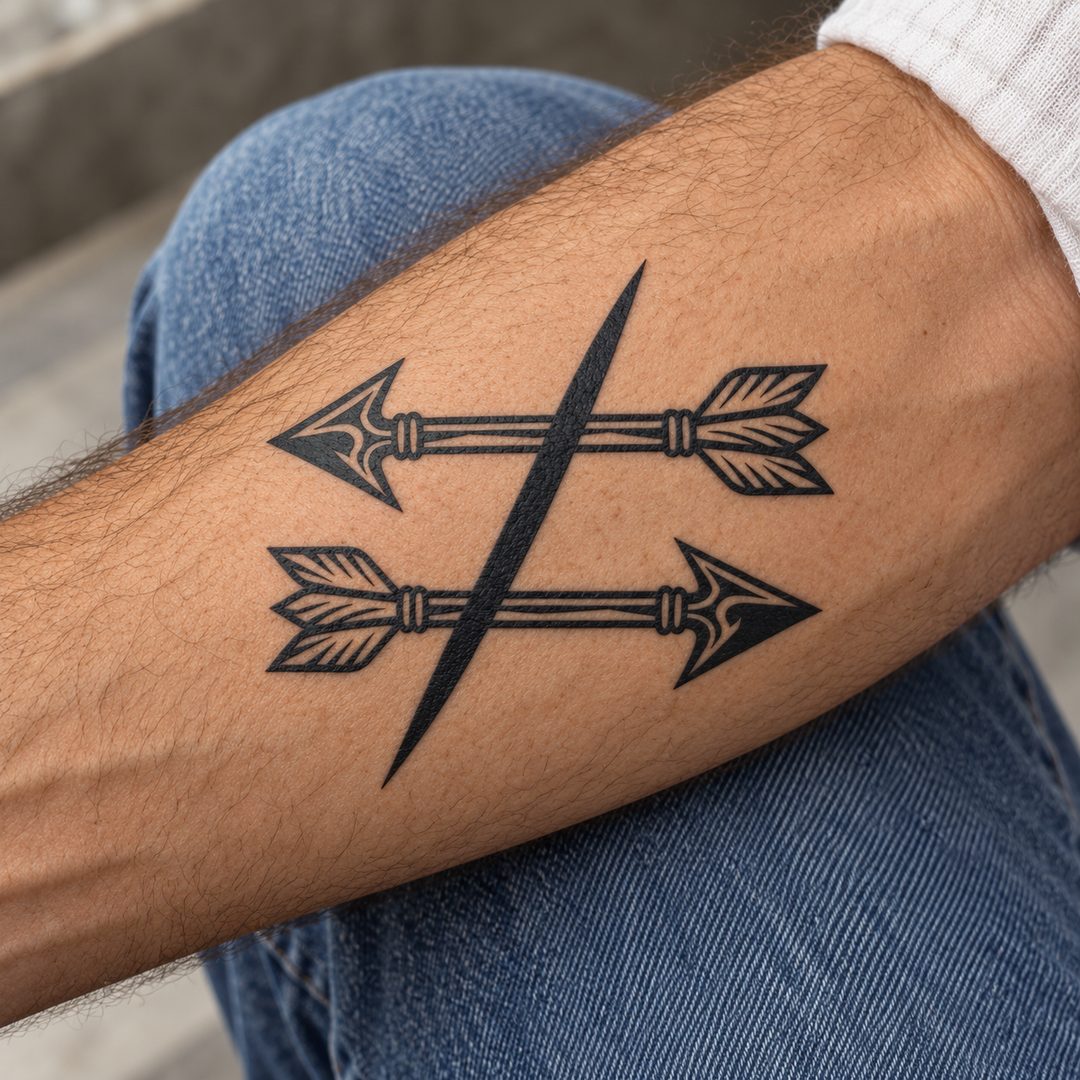
As a tattoo the arrow belongs to the 2010s. It arrived with the fine-line wave, usually a single feathered arrow on the forearm, and quickly became one of the most common first tattoos anywhere. The meaning most people give it: an arrow can only be shot by being pulled backwards, so when life drags you back, it is about to launch you forward. Two arrows crossed are friendship. A bundle of arrows is family or strength in numbers, an idea old enough to be on the American eagle's talons and in the fable of the sticks that cannot be broken together.
The arrow is simple, cheap and easy to hide, which is exactly why so many people start with it. It is also easy to do badly, so read on.
What it means
- Global modern
- Direction, focus, moving forward after being pulled back.
- Friendship and family
- Crossed arrows for friends; a bundle for family strength.
- Cartography
- The plain arrow of maps: this way.
Best place to wear it
Inner forearm Top pick
The natural home: a long straight line on a long straight surface.
6 to 12 cm
Pain 3/10 · heals in about 14 days
Ankle
A small arrow above the ankle bone, easy to hide, easy to show.
3 to 5 cm
Pain 6/10 · heals in about 21 days
Spine
A single vertical arrow down the spine is striking. The sitting is not gentle.
15 to 25 cm
Pain 8/10 · heals in about 21 days
Get it right
An arrow is a straight line on a body that is not straight, so placement is the whole job. On the forearm, run it along the bone; across it, it will bend every time you turn your wrist. The shaft must be one confident pass: a wobble in a long thin line cannot be hidden. Fletching drawn with many fine barbs blurs into a smudge; ask for fewer, bolder feathers or a clean outline. Decide which way it points, and why. Small arrows can go below 3 cm but the head and feathers need at least a little room. If you want words along the shaft, proof them like any lettering.
Styles that suit it
Related
Sources
Researched from the sources below; cultural review pending.