Wave
Hokusai's Great Wave is on a million arms. Here is how to make yours yours.
Around 1831 an old man in Edo cut a wave into a block of cherry wood. Katsushika Hokusai was past seventy and said he had not drawn anything worth keeping before that age. The print sold for about the price of a bowl of noodles, thousands of copies, three small boats under a wall of water and Fuji sitting calm behind it. It is the sea he knew: you do not beat it. You ride it, and you keep going.
Worth knowing
The story
Around 1831 Katsushika Hokusai published The Great Wave off Kanagawa, the first print in his series Thirty-six Views of Mount Fuji. A huge wave with claw-like fingers of foam towers over three fishing boats, while Fuji sits small and still in the distance. It was a cheap woodblock print, made in the thousands, and it is now probably the most recognised image in Japanese art. Despite the nickname, it is not a tsunami; the Japanese title describes an ordinary offshore wave.
Water was already central to Japanese tattooing, where waves are the background that ties a koi, a dragon or a warrior to the body. The Great Wave itself has been tattooed so often, on forearms, wrists and ankles, in full colour and single line, that it is now one of the most overused images in the trade. Artists will still do it, but many will tell you so.
The wave's meaning is the sea's: power you cannot argue with, change that keeps coming, the choice to ride it rather than fight it. For a landlocked country it can also just mean the ocean you dream of. Polynesian tattooing has its own wave patterns, which belong to a tradition with owners; see the note below.
What it means
- Japanese (ukiyo-e)
- Nature's force against human smallness, with Fuji's stillness behind.
- Japanese (irezumi)
- Water as life and movement; the ground a koi or dragon lives in.
- Polynesian
- The ocean as road and ancestor. Pattern language with its own rules.
- Modern
- Resilience, change, going with the flow.
Best place to wear it
Inner forearm Top pick
The most common home for the Great Wave, and flat enough to keep the foam sharp.
8 to 12 cm
Pain 3/10 · heals in about 14 days
Upper arm (outer)
Japanese water wraps the arm as background to a koi or dragon.
15 cm and up
Pain 3/10 · heals in about 14 days
Ankle
A small crest just above the bone. Simple line only; detail will not survive here.
3 to 5 cm
Pain 6/10 · heals in about 21 days
Get it right
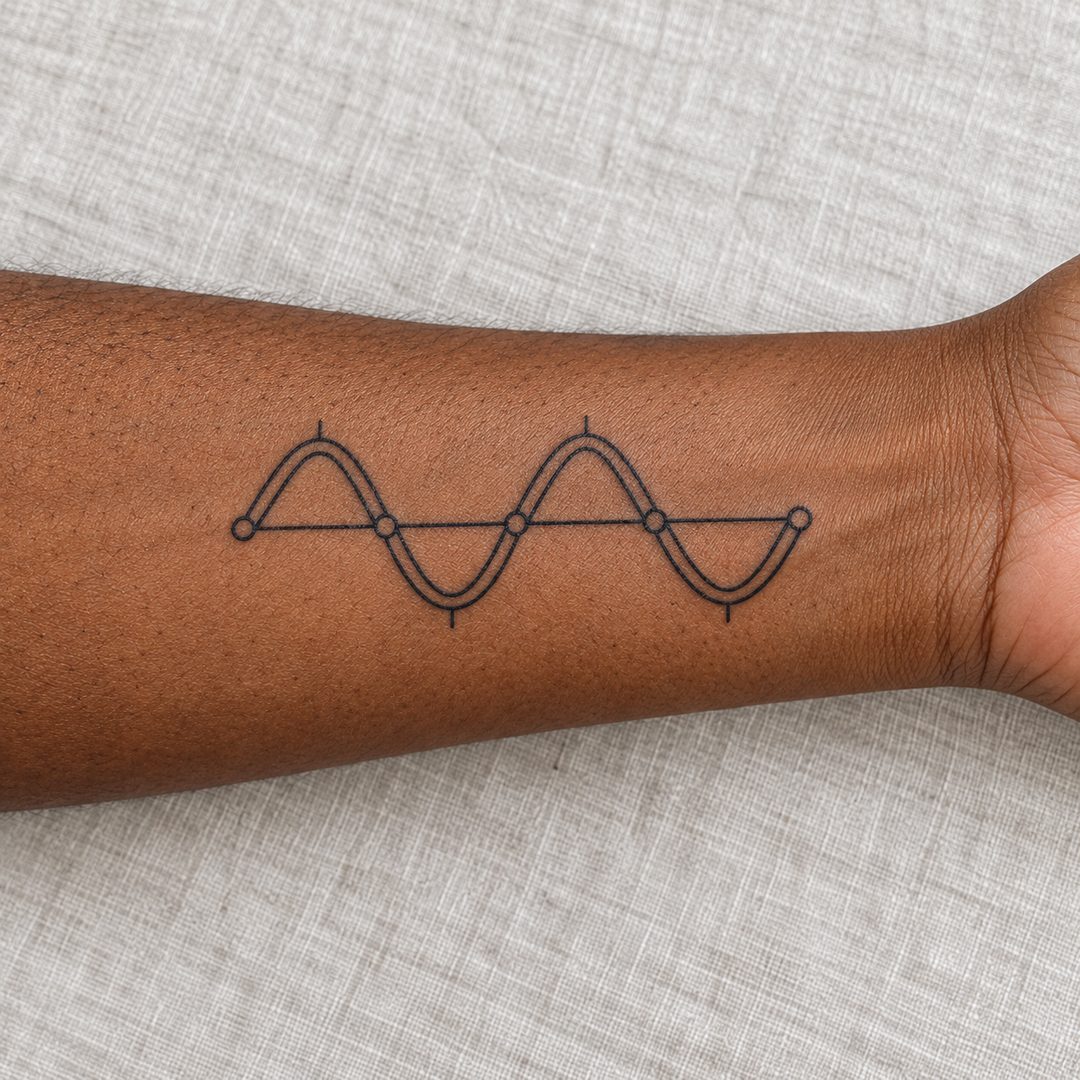
Hokusai's print is public domain, which is exactly why it is everywhere. If you love it, wear it big enough for the foam fingers to read, 8 cm or more; miniature versions lose the claws within a few years and become a blue smudge. The flat colour areas need clean edges, so pick an artist who does solid colour well. A better route is to ask your artist to draw Japanese-style water around something of yours, a koi, a place, a name, so the wave is a setting rather than a copy. Single-line minimal waves are fine on the forearm and weak on the wrist. For any Polynesian-looking pattern, ask where the design comes from.
Styles that suit it
Related
Sources
Researched from the sources below; cultural review pending.