Penrose Triangle
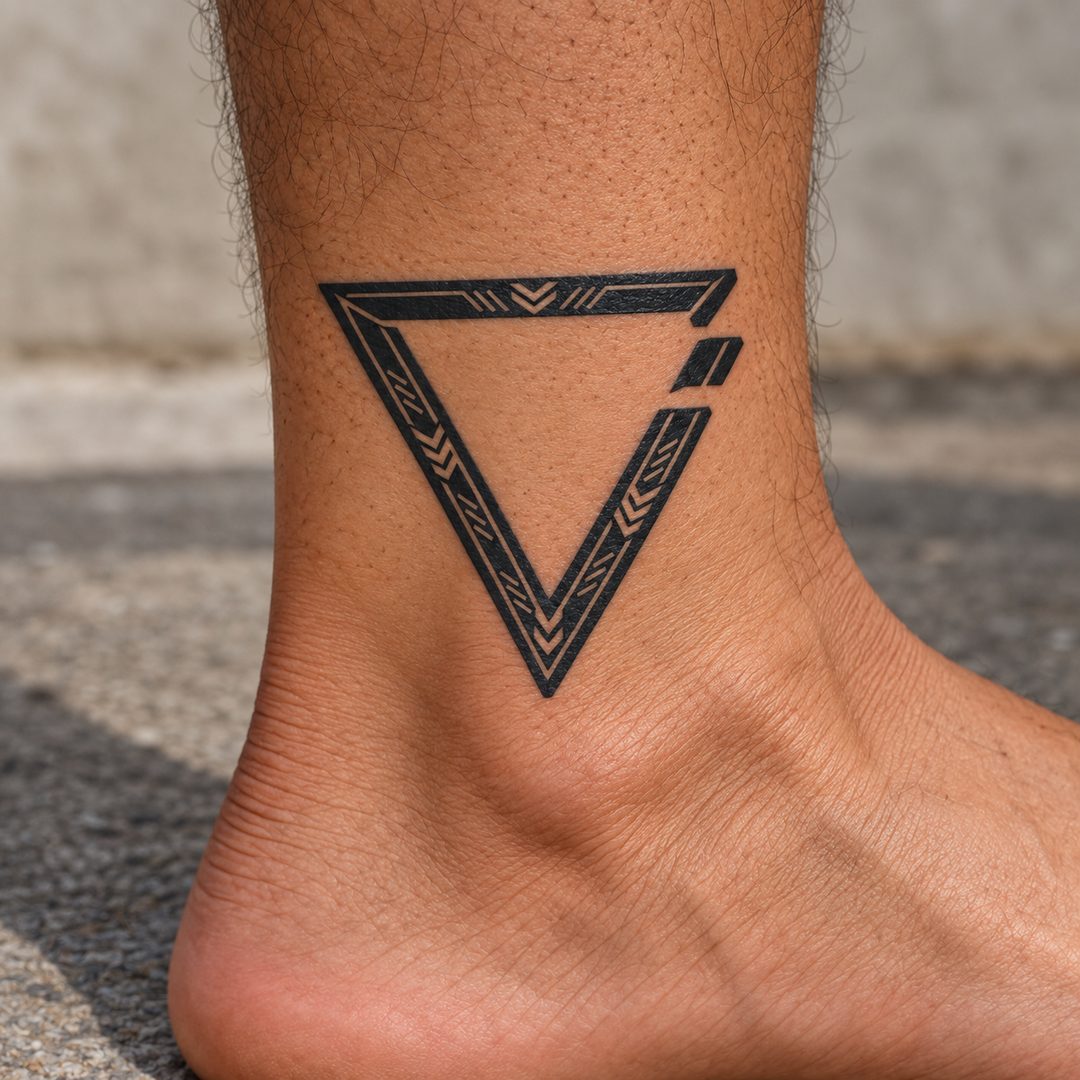
The impossible triangle. Every corner is correct, and the whole cannot exist.
In 1934 a Swedish schoolboy, Oscar Reutersvard, was doodling in a Latin lesson and drew a ring of cubes that could not exist. Twenty years later the mathematician Roger Penrose, who had never seen it, drew the same impossible shape after a lecture by M. C. Escher, and published it with his father in 1958. Escher then built a waterfall from it that flows uphill forever. Every corner is right. The whole thing is impossible, and there it is anyway.
The story
Look at any one corner of the Penrose triangle and it is an ordinary right angle where two square beams meet. Follow the beams round and they cannot join up in real space: each corner is possible, the object is not. The Swedish artist Oscar Reutersvard drew the first version in 1934, as a ring of cubes, and went on to make thousands of impossible figures; Sweden put some of them on postage stamps in 1982.
The name comes from Lionel Penrose, a psychiatrist and geneticist, and his son Roger, a mathematician, who drew it independently and published it in the British Journal of Psychology in 1958 as a study of how the eye builds a solid from a flat picture. They sent it to M. C. Escher, who used the idea in Waterfall in 1961, a mill stream that runs downhill all the way round and arrives back at the top. Roger Penrose went on to share the Nobel Prize in Physics in 2020 for his work on black holes. In East Perth, in Australia, a large aluminium sculpture built in 1999 looks exactly like the impossible triangle, but only from one spot; step aside and its beams come apart.
As a tattoo it means the impossible made real. It is worn by people who were told something could not be done, and by anyone who likes a paradox they can see.
What it means
- Mathematics
- An impossible object: locally correct, globally impossible.
- Modern
- The impossible, made real. Done anyway.
- Psychology
- How the mind builds a world from a flat picture, and can be fooled.
Best place to wear it
Inner forearm Top pick
Flat and steady: the lines stay parallel.
4 to 7 cm
Pain 3/10 · heals in about 14 days
Upper arm (outer)
A bold version with solid black faces.
5 to 8 cm
Pain 3/10 · heals in about 14 days
Get it right
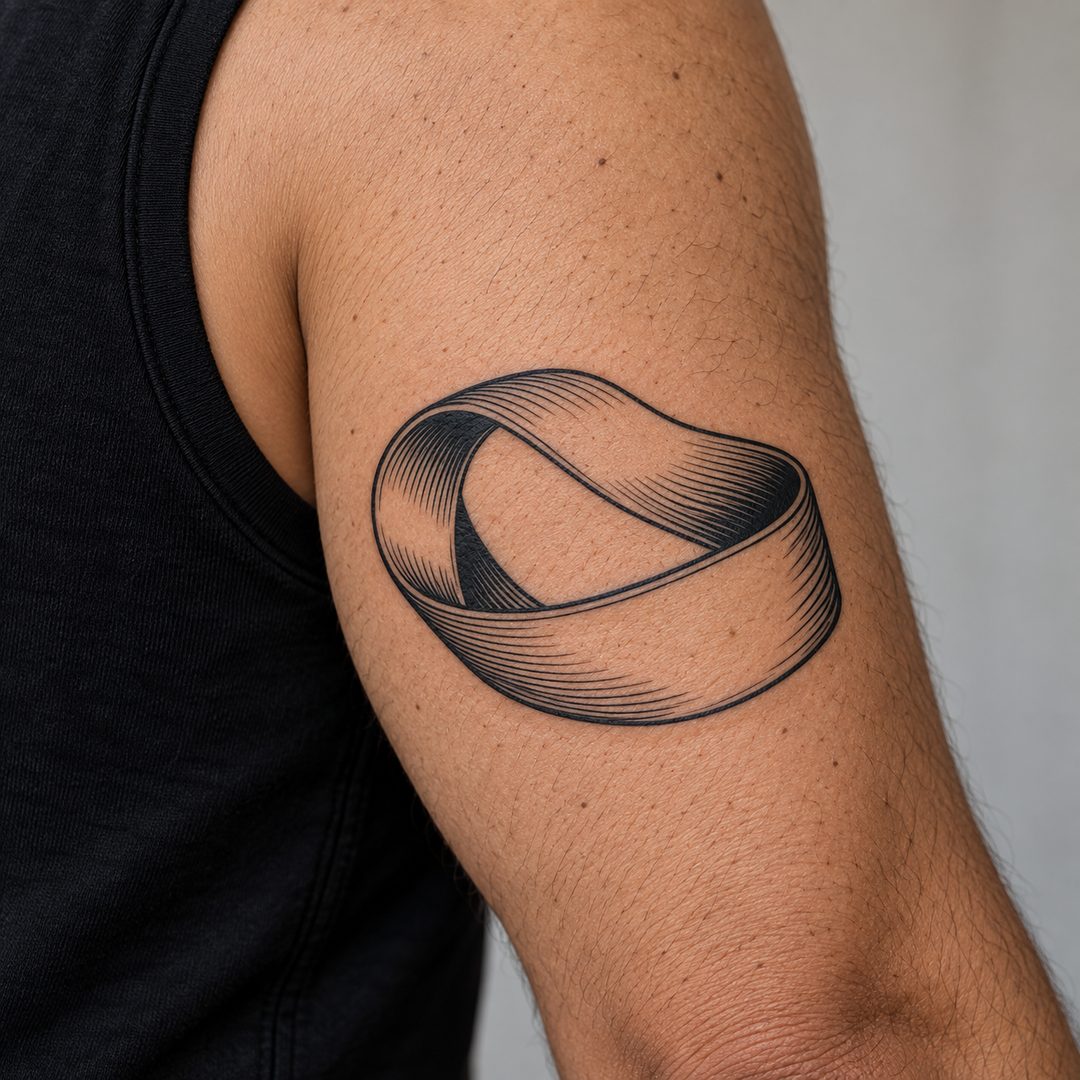
The illusion lives or dies on accuracy. Every line must be parallel to one of the three sides, the three bars must be the same width, and the three corners must be identical copies turned by a third of a turn. Ask the artist to build the stencil on a triangular grid rather than draw it by eye; one line out of place and it becomes a flat, odd triangle. Shading one face of each bar, light, medium and dark, makes it read at once. Keep it at 4 cm or more across so the inner triangle does not close up. The flat skin of the inner forearm, the shoulder blade or the back of the upper arm keeps the lines true.
Styles that suit it
Related
Sources
Researched from the sources below; cultural review pending.