Integral
A tall, stretched S. The whole built from countless small moments added together.
The story
The integral sign is a long S, stretched tall. Gottfried Wilhelm Leibniz first wrote it in a manuscript dated 29 October 1675, taking the old long form of the letter S from summa, a sum, and it appeared in print in 1686. It asks for a special kind of sum: slice something into infinitely many infinitely thin pieces and add them all back together. That is how you find the area under a curve, the distance travelled from a changing speed, the total from a rate.
Isaac Newton had worked out the same ideas earlier, in private, and the argument over who invented calculus became one of the bitterest in the history of science. In 1712 the Royal Society in London set up a committee to settle it, and ruled for Newton. The Society's president at the time was Newton, and he wrote much of the report himself. Leibniz's notation won all the same: the long S and his dx are what every student learns today, because they work so well on paper.
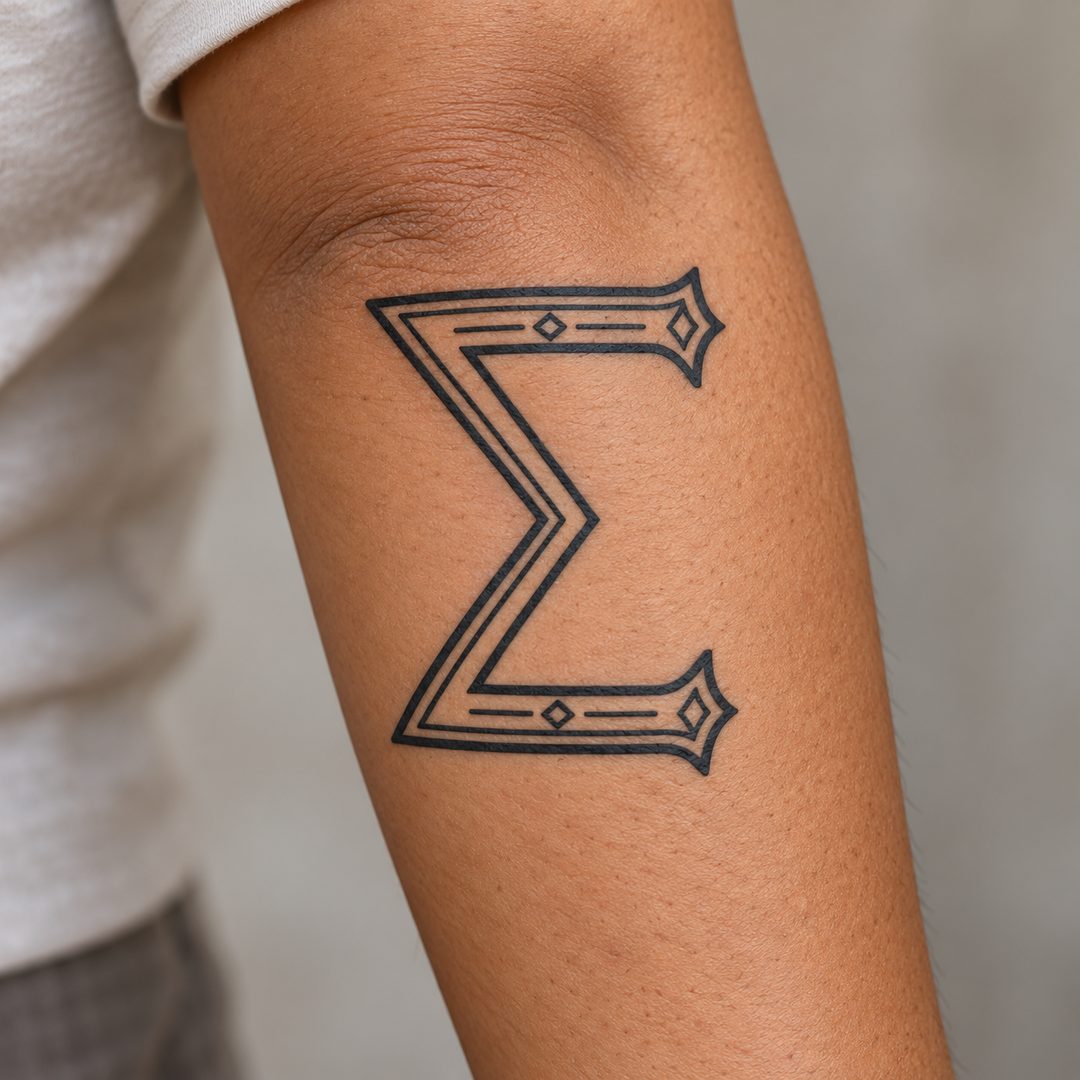
As a tattoo it is about accumulation. No single slice has any size at all, and yet together they make the whole area. People choose it for recovery and for long work: every day is almost nothing on its own, and the total is a life.
What it means
- Mathematics
- The integral: the sum of infinitely many infinitely small parts.
- Recovery
- Small days add up. The total is made of moments that each seemed like nothing.
- Modern
- Integrity, being whole. The pun is part of why people choose it.
Best place to wear it
Inner forearm Top pick
The tall S runs with the arm.
3 to 6 cm tall
Pain 3/10 · heals in about 14 days
Hand and fingers
Along the side of a finger. Expect it to fade.
1.5 to 2 cm tall
Pain 7/10 · heals in about 21 days
Get it right
The sign is a tall, slim S leaning slightly forwards, with a small hook at the top curling right and one at the bottom curling left. Ask for the textbook shape rather than a decorative script S; if it is too upright it reads as a letter f or a J. Its height should be about four times its width. If you add limits or a function, such as the integral of dx, check every character and keep them at least 3 mm tall. The sign alone needs a bold line and 3 cm or more in height. A long, narrow shape suits the inner forearm, behind the ear or down the side of a finger.
Styles that suit it
Related
Sources
Researched from the sources below; cultural review pending.