Fine Line Face
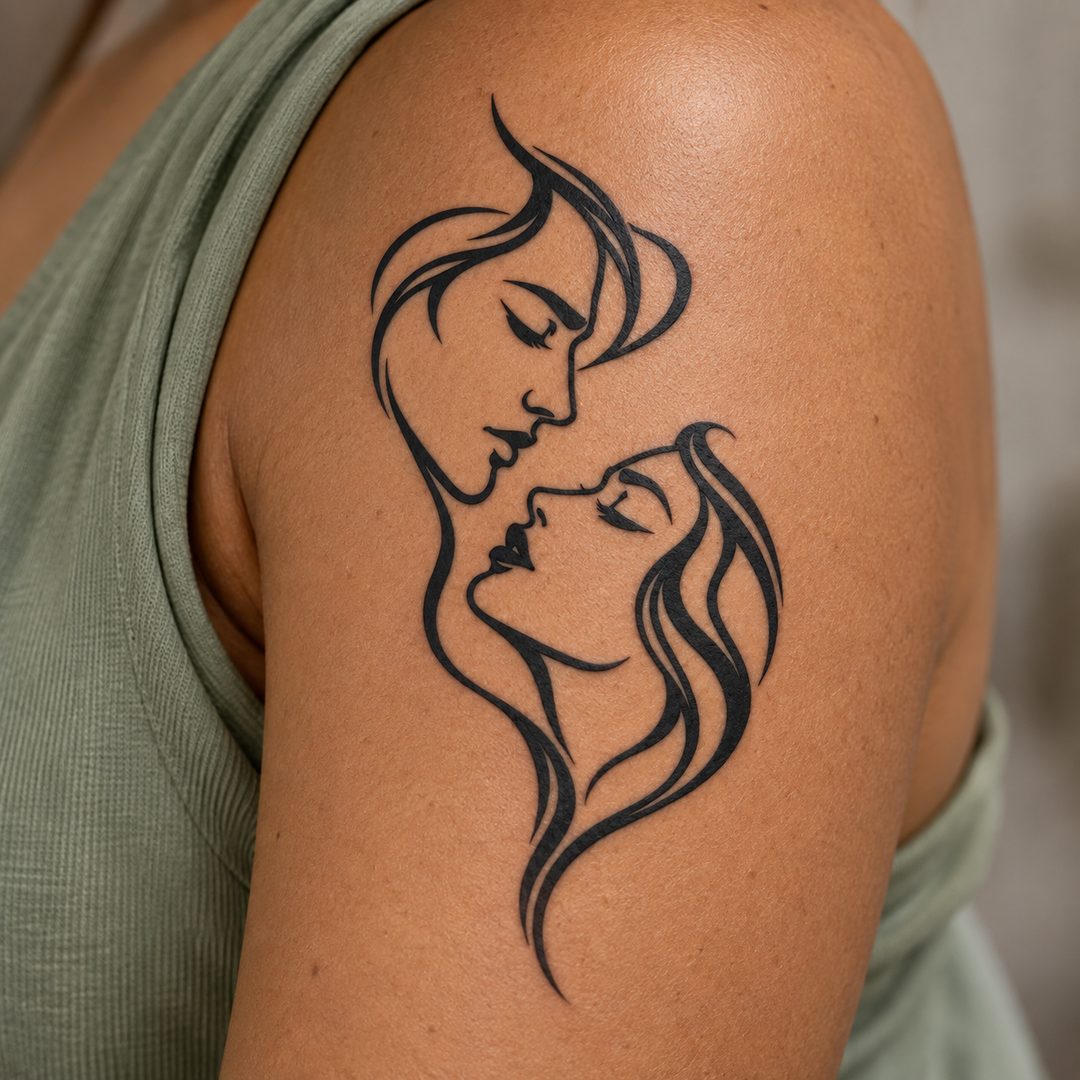
A face in a few unbroken lines. Hair, brow, lashes, lips, and nothing that does not need to be there.
The story
Fine line tattooing grew up in Los Angeles in the 1970s, in the Chicano neighbourhoods where single-needle work, done first with homemade machines, allowed a delicacy the older bold style could not manage: portraits, script, and faces drawn with the lightest possible touch. It stayed a regional speciality for decades, then spread worldwide in the 2010s as machines, needles and ink improved and social media rewarded work that photographs well.
The fine line face is its signature piece. A woman's profile or three-quarter face drawn in a handful of continuous lines, with the hair as one flowing shape and the features reduced to a brow, a lash line and a mouth. Some are portraits of a real person; most are not, and stand instead for femininity, beauty, or a version of the wearer.
It is one of the most requested designs of the last ten years and one of the most unforgiving to get wrong, which is why it belongs to artists who draw well on paper first.
What it means
- Modern
- Femininity, self-possession, beauty on your own terms.
- Personal
- A mother, a daughter, a sister, or the wearer herself.
Best place to wear it
Inner forearm Top pick
Flat and steady: the lines stay where they were put.
10 to 14 cm tall
Pain 3/10 · heals in about 14 days
Upper arm (outer)
Room for a larger face, and easy to cover.
12 to 18 cm tall
Pain 3/10 · heals in about 14 days
Shoulder blade
The classic spot for a portrait that is meant to be seen from behind.
14 to 20 cm tall
Pain 4/10 · heals in about 14 days
Get it right
Line quality is everything. Ask to see the artist's fine line work healed at two years, not fresh; thin lines can blur or fade patchily if they were done too shallow or too deep. Insist on a full-size stencil and look at the eye and the mouth: a lash line a millimetre off changes the whole expression. Keep the piece 10 cm or taller so the features have room. Avoid stacking it on a spot that stretches; the forearm, the upper arm and the shoulder blade hold fine line best. If it is a real person, bring photographs and accept the artist's simplification, since a likeness in six lines is a translation, not a copy.
Styles that suit it
Related
Sources
Researched from the sources below; cultural review pending.