Dopamine
The molecule of wanting, of drive and anticipation. A ring, two hydroxyls and a chain.
The story
Dopamine was first made in a laboratory in 1910, by George Barger and James Ewens at the Wellcome labs in London, and for almost fifty years it was thought to be only a step on the way to adrenaline. In 1957 and 1958 the Swedish pharmacologist Arvid Carlsson showed that it was a messenger in the brain in its own right, and that animals drained of it froze, unable to move, much as people with Parkinson's disease do. His work led to L-DOPA, still the main treatment for Parkinson's, and in 2000 to a Nobel Prize.
It is usually called the pleasure chemical, and that is not quite right. Work by Kent Berridge and others since the 1990s suggests dopamine is less about enjoying a thing than about wanting it: the pull towards a reward, the anticipation, the drive to go and get it. That is also why it sits at the centre of addiction, where wanting carries on long after liking has gone.
As a tattoo it is worn for joy and for drive, for the chase more than the prize. It is worn in recovery too, by people who know exactly what it does. Dopamine itself cannot cross from the blood into the brain, which is why Parkinson's patients are given L-DOPA, the molecule one step before it, and the brain finishes the job.
What it means
- Chemistry
- A catechol ring with two hydroxyls and an ethylamine chain.
- Neuroscience
- Wanting, motivation, anticipation of reward.
- Modern
- Joy and drive. Often paired with serotonin.
Best place to wear it
Collarbone Top pick
Long and low: the chain follows the bone.
4 to 6 cm wide
Pain 7/10 · heals in about 14 days
Ankle
A small, private version on the side of the foot.
3.5 to 4.5 cm wide
Pain 6/10 · heals in about 21 days
Get it right
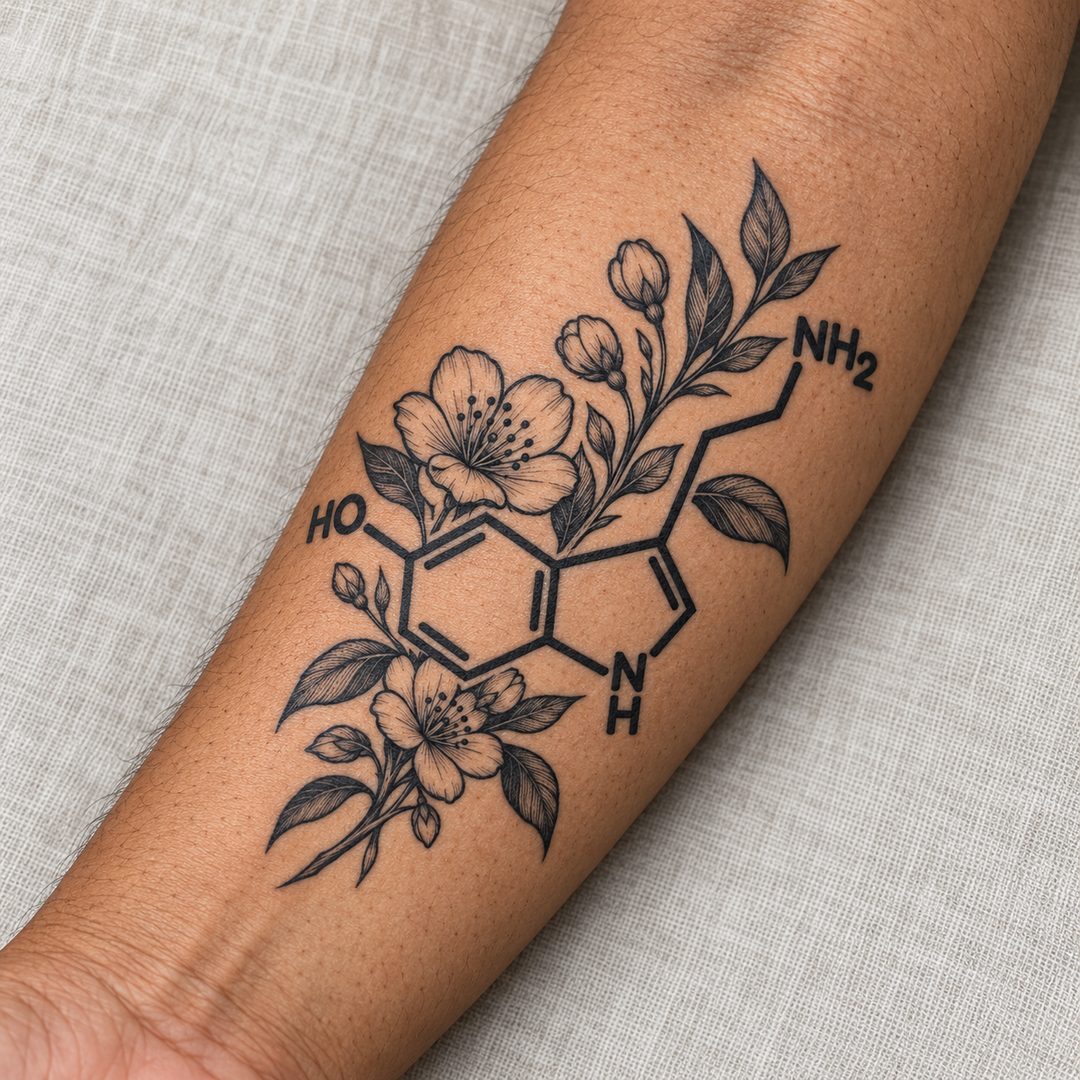
The details that make it dopamine: a six-sided ring with alternating double bonds, two HO groups on neighbouring corners on one side, and on the opposite side a chain of exactly two carbons ending in NH2. Three carbons, or the HO groups spread apart, make it a different molecule. Check the stencil against a chemistry source rather than a tattoo photo. Ask for plain, even letters at least 3 mm tall and a clean hexagon drawn with a guide. It is long and low, so it suits the collarbone or the inner forearm, 4 to 6 cm wide.
Styles that suit it
Related
Sources
Researched from the sources below; cultural review pending.