Approximately Equal
Two wavy lines that mean close enough. A quiet answer to perfectionism.
The story
The sign of two wavy lines means 'approximately equal to': not exact, but near enough for the purpose. The British mathematician Alfred George Greenhill introduced it in 1892 in a book on elliptic functions, and it has been used ever since wherever an honest answer is a close one.
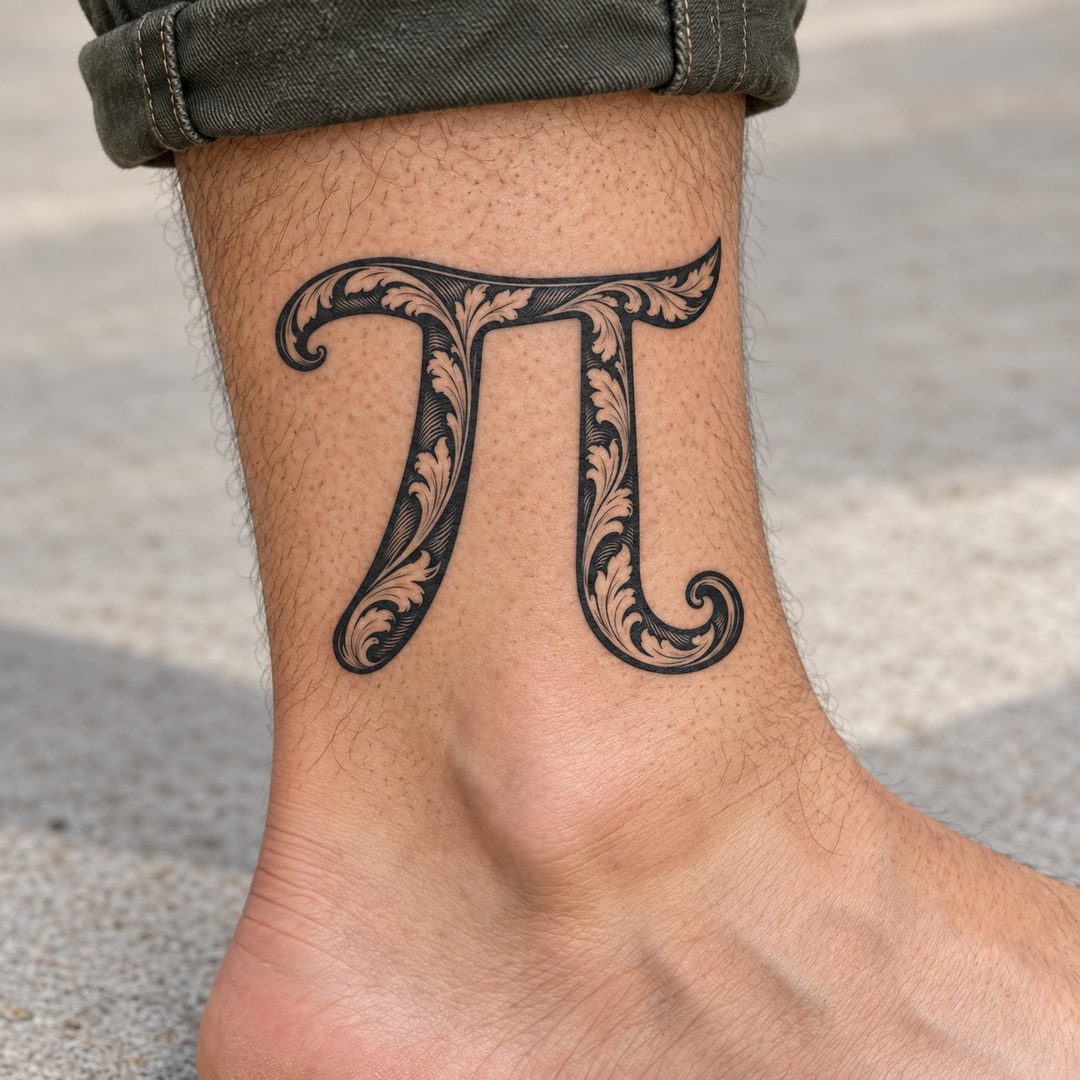
Most of mathematics in the real world is approximate. Pi cannot be written down exactly, so Archimedes used 22/7, and in fifth-century China Zu Chongzhi found 355/113, which is correct to six decimal places; for almost nine hundred years nobody computed pi more precisely than he had. Every bridge, aircraft and engine is made to tolerances, a stated amount by which each part is allowed to be wrong, because exact is not possible and near enough, done carefully, is what keeps things standing.
As a tattoo it is a reminder against perfectionism: close enough is enough. It is chosen after burnout and in recovery from eating disorders and anxiety, by people learning that an approximate life, lived, is worth more than an exact one never finished. It is also a sibling tattoo, for two people who are nearly, but never quite, the same.
What it means
- Mathematics
- Approximately equal to: near enough for the purpose.
- Healing
- Close enough is enough. Permission not to be perfect.
- Siblings
- Nearly the same, never quite.
Best place to wear it
Hand and fingers
On the side of a finger. It will fade.
1 to 1.5 cm
Pain 7/10 · heals in about 21 days
Get it right
Two details stop it becoming something else. The lines must be waves, not straight, or it is an equals sign; and there must be two of them, since a single wave is a tilde, which means 'similar to'. Ask for the waves to be the same shape, one exactly above the other, with a gap of at least 3 mm so they stay apart as they settle. The sign is naturally small; keep it at least 1.5 cm wide with a bold line. Between two things, a name and a word, or two dates, it reads as a sentence. The wrist, a finger or the inner forearm suit it.
Styles that suit it
Related
Sources
Researched from the sources below; cultural review pending.